My homelab is a k3s cluster spread across a few Mac minis. Linux VMs via Lima, Tailscale for the network, and Flux reconciling everything from a git repo. I gave the full tour of that architecture over on the homelab page. This post is about secrets. I recently ripped SOPS out of that repo and replaced it with Infisical, and Infisical ended up doing way more jobs than I planned to give it.
I count at least eleven. Let's go.
Life under SOPS
For a long time every secret in my cluster lived in git as an age-encrypted YAML file. Flux decrypted them at apply time, which meant a decryption block in every single Kustomization. All 26 of them. Rotating a secret meant re-encrypting a file and pushing a commit. The age key was the crown jewel, one file hand-carried between machines that could decrypt everything I own.
Here's what rotating one secret actually involved.
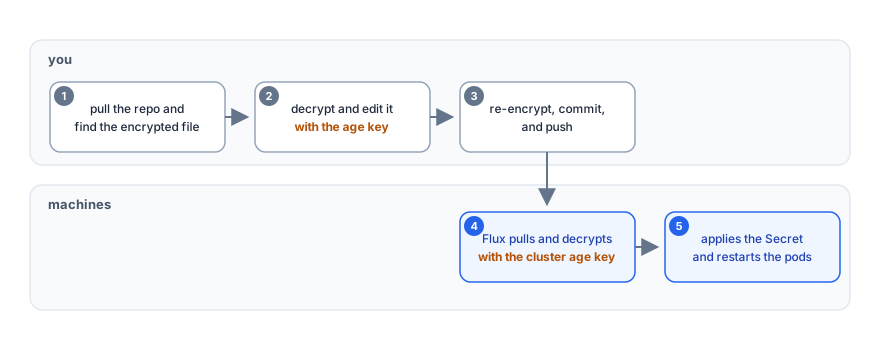
It worked. It was fine. But every new app meant another encrypted file, another decryption block, another chance to fat-finger the recipient list. And the longer I ran it, the less comfortable I got with a single key that decrypts everything forever.
Two Infisicals
The replacement is two tiers.
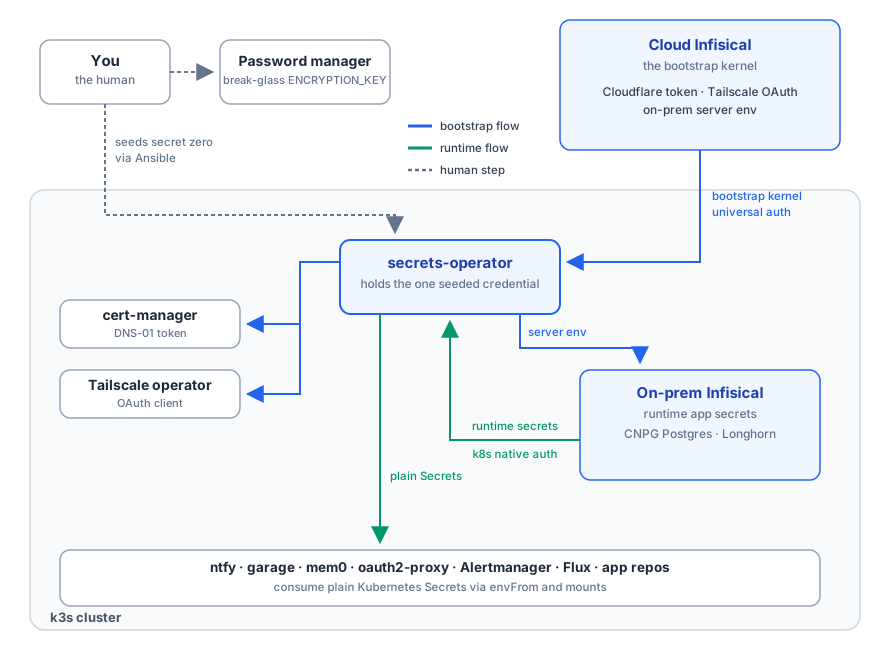
On-prem Infisical, self-hosted in the cluster, is the source of truth for runtime app secrets. Every app gets its own project and its own machine identity. If an app reads an API key at runtime, it comes from here.
Cloud Infisical holds exactly three things in a project I call the bootstrap kernel. The Cloudflare token cert-manager needs for DNS-01, the Tailscale OAuth client, and the on-prem server's own environment.
Why the split? Because the on-prem server's database lives on storage inside the cluster it serves. On a full rebuild nothing can come from on-prem because on-prem doesn't exist yet. Anything needed before the secret store exists has to live somewhere else.
One warning here. The tempting move is to also put your on-prem admin credentials in cloud so a rebuild is fully hands-off. Don't. If cloud gets compromised, the attacker now reads runtime secrets from your publicly reachable on-prem instance. My cloud tier can bootstrap the platform, but it can't read a single app secret.
Here's the whole system on one picture.
Infisical bootstraps Infisical
Here's my favorite part. The on-prem server needs an ENCRYPTION_KEY and AUTH_SECRET in its environment before it can start, and a server can't fetch its own encryption key from itself.
So the on-prem server's env is delivered by a cloud-backed InfisicalSecret. Infisical delivering Infisical's secrets to Infisical. The operator pulls them from cloud, materializes a plain Kubernetes Secret, and the server boots off it like any other app.
One hack I recommend. Export the ENCRYPTION_KEY to your password manager anyway. A wrong encryption key doesn't error politely. It just makes the server unable to read its own data. Ask me how I know to be careful here.
Runtime secrets with zero stored credentials
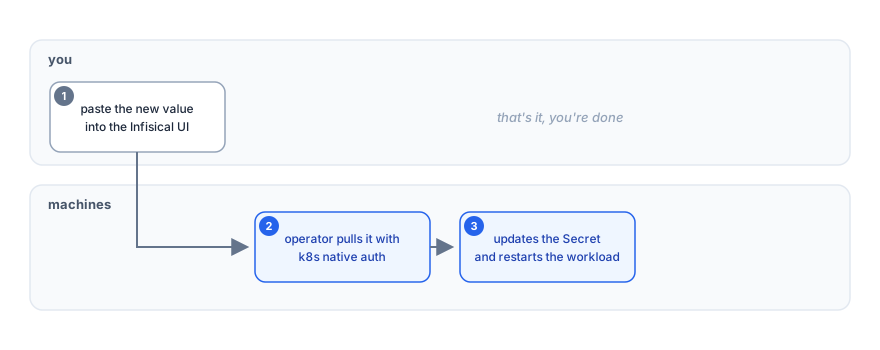
This is the job that sold me. Every app's machine identity uses Kubernetes native auth. The operator presents the app's ServiceAccount token and the Infisical server validates it against the cluster's TokenReview API.
There is no clientId or clientSecret for any app, anywhere. There's nothing to leak and nothing to accidentally commit. Each identity is pinned to exactly one ServiceAccount in one namespace, with viewer access to one project.
The apps themselves have no idea Infisical exists. The operator turns each InfisicalSecret CR into a boring native Kubernetes Secret, and pods consume it with envFrom or a volume mount like it's 2016. The whole CR looks like this.
apiVersion: secrets.infisical.com/v1alpha1
kind: InfisicalSecret
spec:
  authentication:
    kubernetesAuth:
      identityId: <the app's identity>
      serviceAccountRef:
        name: myapp-infisical
        namespace: myapp
  managedKubeSecretReferences:
    - secretName: myapp-secrets
      secretNamespace: myapp
And here's the same rotation from the SOPS diagram, today.
One secret to carry
Under SOPS my secret zero was an age key that decrypted everything. Now it's a single cloud machine identity with viewer access to three bootstrap secrets. Losing it exposes those three secrets and nothing else.
It gets seeded by a one-shot Ansible playbook that reads the credential from environment variables instead of -e flags, because your shell history is not a secret store. The playbook writes it into the cluster as the one Secret the operator uses for cloud pulls.
I'd much rather babysit one tightly scoped credential than a god key.
Everything else it quietly does
This is where "umpteen" earns the title. Once the pattern existed, everything migrated into it.
- Flux's GitHub webhook token, so pushes trigger reconciles instantly
- Alertmanager's ntfy token, so my phone buzzes when something breaks
- cert-manager's Cloudflare token and the Tailscale operator's OAuth client, both on the cloud tier
- oauth2-proxy's session secrets, my S3-compatible storage keys, an OpenAI API key, and auth for half a dozen app repos that ride the same per-app pattern
A couple of design details are doing quiet work here too.
- The operator talks to the server over internal cluster DNS, so an in-cluster reconcile never touches Traefik, Cloudflare, or a TLS handshake.
- Apps that read secrets as env vars get an auto-reload annotation, so a rotation restarts them automatically. Apps that mount secrets as files, or re-read them per request, deliberately skip the annotation because kubelet and the app already handle updates. You have to know how each workload actually reads its secrets.
My favorite detail is that one of my apps has no runtime secrets at all, so it has no Infisical dependency at all. Apps that don't need the pattern don't pay for it.
The scars
Nobody blogs the error messages, so here are mine.
The Kubernetes auth host must be the full FQDN, meaning https://kubernetes.default.svc.cluster.local. The server's resolver doesn't apply the cluster DNS search domain, so the short name you'd naturally type fails with ENOTFOUND and no further explanation.
The server will refuse to call the cluster API at all until you set ALLOW_INTERNAL_IP_CONNECTIONS=true. That's its SSRF guard doing its job, but the failure looks like broken auth instead of a guard.
Orphaned Secrets stay dead. I use creationPolicy: Orphan so the operator would overwrite my old SOPS-managed Secrets in place during cutover instead of fighting them. The catch is that if a managed Secret gets deleted out from under the operator, say by a Flux prune, the operator's cache still says synced and it never recreates it. The fix is restarting the operator. Learned that one in production, if a homelab has production.
prune: false on the secret store itself. The server's database sits on volumes with a delete reclaim policy. One careless Flux restructure could cascade-delete the Kustomization, the PVCs, and every secret I own. So the GitOps machinery doesn't get to garbage collect the secret store.
The honest trade-offs
SOPS plus git was fully offline. My cold bootstrap now needs the internet and Infisical Cloud to be up. A running cluster doesn't care, since the materialized Secrets persist and only rotation pauses. But a rebuild during an outage is a real regression and I'm choosing to accept it.
I also now run a stateful service whose availability gates secret rotation. And Kubernetes auth binds every identity to this cluster, so a full rebuild means re-pointing all of them at the new cluster's CA.
Oh, and migrations leave scars. While writing this post I found a comment in my monitoring config still confidently describing a SOPS-encrypted file that no longer exists. Rest in peace, little comment. 🪦
Should you do this?
If you're happy with SOPS, genuinely, stay. Offline bootstrap and zero moving parts are real features.
But if you've caught yourself dreading a rotation, or you're tired of one key that decrypts everything you own, the shape that worked for me is to put the bootstrap kernel somewhere that survives your cluster, put everything else on-prem behind Kubernetes native auth, and get to a place where exactly one credential exists outside the system, scoped so tightly that losing it costs you almost nothing.
That last part is my favorite. I'm down to carrying exactly one secret, and Infisical handles the other umpteen jobs.